
I may have mentioned that in my ‘spare’ time, I like to take chemistry classes even though I’m not in school anymore. Currently, I’m taking an organic chemistry class using iTunes U (the class is from the University of California at Irvine). My brother happened over one afternoon while I was studying. I put my book away and visited with him, but I left my notebook out and he found it. Much later, I discovered he’d written me a note:
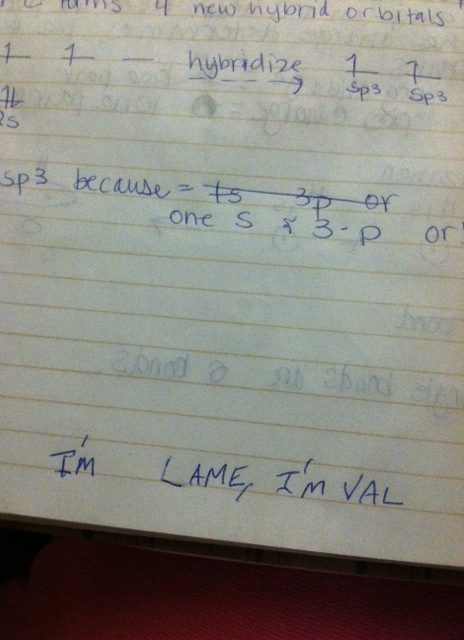 Isn’t he sweet? I know he’s just jealous of me and my brilliant scientific mind. Right?
One of the things I miss about school is doing research, but that can be done at any time, really. You don’t have to be in school, you just have to know how to do it properly. I did a lot of research for The Energy Crusades, and I have notebooks of drawings, articles, and pictures that helped give life to the story. Now that I’m writing book 2, I need to do even more research. Sometimes, I get caught up in that and it stalls out my writing. I have to solve the ‘problem’ before I can move forward. I was discussing my latest hiccup with my precious friend Michelle (https://noblevalerie.com/2012/04/02/my-precioussss/) today, and she helped me to work it out, as she ALWAYS does. She had an idea that reminded me of an article I recently studied for my daughter’s physics class (yes, I go over all of her science homework, wishing I was taking the class with her). The article is on ‘Solar Steam’. Check it out here: http://www.sciencedaily.com/releases/2012/11/121119140627.htm
It’s a summary really, of another body of research, so it’s not very long. Solar Steam is exactly the kind of energy I imagine is used by my crusaders. Energy fascinates me and I love to learn about emerging technologies. If you take the time to read the article, let me know what you think.
Today I’m responding to a question posed by YA Misfits here:
The question for today is: If you were an agent for a day, what would be on your wish list?
This is a good question because it draws me out of the constant quest of perfecting my query and trying to find the right agent. I now get to look at the issue from the other side of the coin, so to speak. What would I be looking for if I was an agent? These are the first answers that came to mind:
- Science Fiction– I love this genre and, not surprisingly, my YA novel is light science fiction. I like dystopian, futuristic, end of the world type stuff. I loved The Hunger Games Trilogy (all images courtesy of Amazon).
- Fantasy– I sometimes confuse this with science fiction but when I say fantasy I’m thinking of the Kristin Cashore books (Graceling, Fire, Bitterblue). I also LOVED the book ‘The Hero and the Crown’ by Robin McKinley.
- Historical Fiction– I wouldn’t mind seeing more of this for the YA genre. If it exists, which it must, I’m not aware of it. I loved Phillipa Gregory’s ‘The Other Boleyn Girl’, but that book is definitely not YA. I remember loving the book ‘Johnny Tremain’ by Esther Forbes back when I was a ‘young adult’ myself.


How fun would it be to look through queries and read all the wonderful ideas out there? It might not be as fun as it appears, especially after doing it for a long period of time, but still, I’d love to give it a try. Thanks to YA Misfits for posing the question. If you feel like commenting, let me know what you would want to see if you were an agent.
I recently posted about my experience meeting the author Catherine Ryan Hyde and how lucky I was to have her as my mentor at a writers conference. She graciously agreed to let me interview her on this blog, and I loved the interview and the encouragement she gave to other writers. To honor her, I am participating in the giveaway hop (see photo above) hosted by Adam at http://roofbeamreader.net.
When I asked Catherine which book of hers I should read first, she suggested ‘Becoming Chloe’. I bought that book at the conference where we met. I cannot part with that book, but I definitely want to share the message of paying it forward. As an aspiring author myself, I would like to support other aspiring authors who are trying to get their work out there. Here is my contest: post in the comments about an author who’s work you would like to see more of and why. If possible, suggest a book by that author. The contest is open until June 30th, at which time I will pick a winner from all of the entries. The winner will receive a $25 gift card to Amazon.com to buy the book of his or her choice. I will also personally buy a book from the author the winning entry recommends. Easy enough? I can’t wait to hear your suggestions.
I generally don’t make it a habit to blog about anything too personal. I rarely mention my husband and daughter because, honestly, they get a lot of me and my shenanigans at home and don’t need to be dragged into them in a public forum as well. However I feel compelled to write about my husband, Mike Noble, the man I refer to as my sun and stars. He may not be Khal Drogo,

But everything I have in this life, or ever will have, is because of him. That makes him my sun and stars. Every day with Mike Noble is fun and that is no exaggeration. He is never grumpy, he rarely gets upset, and I’m pretty sure he has never, ever said an unkind word to me or called me any kind of derogatory name. We’ve been married for nearly 16 years, and we have a teenager so that is no easy feat.

Look at that face! That is how he is ALL the time- happy. You’re probably thinking ‘well, you’re such a perfect wife, what does he have to be upset about?’ Which is true, but here’s a sampling of what he’s put up with over the course of our married life. When I decided I wanted to go back to school to be a food scientist, he said ‘go for it’. When a parade of students came tromping through our house throughout my school years, studying, visiting, hanging out or whatever, Mike took it in stride. It wasn’t unusual for him to come home from work to my friends and me talking about chemistry or some other enthralling subject. During my school years he also bore most of the responsibility of getting our daughter to and from school, making all of her lunches and just generally being there at a time when I was often absent.
When I decided I wanted to play tennis regularly, I demanded that he make the time to play with me at least twice a week. He said ‘I’ll do it’. I might mention that he was a collegiate athlete and is a foot taller than me, so we were a little unmatched on the tennis court (A LITTLE!). When I complained about this and demanded that he let me take tennis lessons with the same coach as our daughter, he said ‘fine by me’. When I decided to take up running in addition to tennis, I asked him to run with me to help keep me motivated. I had a few friends join me for my runs here and there, but it was Mike who ran with me consistently (and still does!), even if he is a mile ahead of me on the trail. I can see him up there waiting for me every now and then.
When, in the midst of studying for food science, I decided I was also going to write a book, Mike said ‘bring it on’. He was then present for countless hours of character conversations, plot points, discussions about energy suits, arguments over the technical aspects of the story, and on and on and on. He listened, he gave his opinion at times, but above all, he encouraged me, supported me, and believed 100% that I could do it. There is never an eye roll with him or a ‘what are you going to do now?’ Instead, he says ‘sure, you can do that, I believe in you’. I sincerely mean it when I say I thank my lucky stars for him every single day. He makes life fun and he’s fun too. There is a saying that goes something like ‘behind every great man, there is a great woman’. For me, it has been the man who stands behind me, quietly encouraging me and always saying ‘you can do it, I know you can’. He is my sun and stars.
Back in March, I attended a writers’ conference hosted by the Andrea Brown Literary Agency (http://andreabrownlit.com/.The) experience was extremely valuable and I highly recommend attending one of these conferences if you have the time and money. Andrea Brown and her staff are true professionals, and you will walk away having learned a great deal about your writing, and hopefully with many new friends, as I did. Many of the writers attending the conference are repeat customers. I hope to be one myself.
During the conference, I was lucky enough to have the author, Catherine Ryan Hyde, as one of my mentors. You may have heard of her, she’s written several novels (18, I think? And the number is growing!), including Pay It Forward, which was made into a feature film. You can learn more about her here: http://www.catherineryanhyde.com/
Catherine was kind, but tough. She let you know what worked, what didn’t, and why. She took the time to critique, while also encouraging us to hold onto our own voices in our storytelling. Since the conference, I have kept in touch with Catherine, and she graciously agreed to be interviewed for my blog. While there are probably 1000 questions I would like to ask her, I tried to think about what would be helpful to all aspiring authors. I have kept her answers as she wrote them. Please let me know if you’d like me to ask any follow up questions, and remember to check out her blog and read her books!!! She’s a wonderful human being.
What is the most significant change you’ve seen in the publishing industry since you were first published?
Without a doubt, the ebook revolution. It’s changed the entire landscape. Used to be, you could only make money as an author if Big New York Publishing said you could. Now anybody with a really good book to sell can get in on the game. I’m not saying it’s easy, or even a lot easier. But it’s possible. Reminds me of what happened to film when we all gained access to computers, video editing software, and good quality video cameras for not much money. All of a sudden you didn’t have to be a big corporation. You could get in the game and make a great film for just a few thousand dollars. It leveled the playing field. I like a level playing field, so, in spite of the fact that there’s a downside to the ebook revolution, I’m still a fan of it. I’d rather have ten crappy, badly-edited books go up on Amazon than see one really talented writer get locked out of the process.
What was your first published novel?
Funerals for Horses, a (very) small press novel that came out in 1997. The publisher went belly up less than a year later, but it got great reviews, which helped set things in motion.
How did you get the attention of a publisher?
I wrote short fiction, and marketed it myself to literary and small circulation magazines. It helped a lot. Before I had any short stories published, I queried more than 25 agents with my first novel. Not a single one wanted to see another thing from me. After I had published three short stories and received an honorable mention in the Raymond Carver Short Story Contest, I queried five more agents. By now I had two novels to sell. All five wrote back immediately and said, “Send both complete manuscripts.” I know it might not be what many writers want to hear, but I highly recommend that process for hammering out your own early publication credits.
Have you ever had to write a query letter?
Many times. More times than I care to recall. It may be hard to imagine, but it gets easier with time.
How did you choose your book agent?
I’ve had three. The first, who didn’t pan out, I met at the Santa Barbara Writers Conference. We connected there, and I gave her a literary magazine containing one of my stories (see what I mean?). Later in the conference, I asked if I could send 30 pages, which is the way she suggests writers approach her. She said, “No, send the whole manuscript, because I already know I like the way you write.” The second, who later left the business, solicited me. That’s a terrific experience. She read my work in a small literary magazine (picking up a pattern here?) and wrote me a letter, forwarded through the editor, asking if I was seeking representation. The third, and current, I met when we were both on staff at the La Jolla Writers Conference. I was just going into YA fiction, and her agency is the best in the business for juvenile. And she was, and is, one of the top agents there, and once I knew she was willing to take me on, there was no choice to be made. I knew I couldn’t do much better. Fortunately, it’s seven or eight years later, and that still seems to be true.
What are your thoughts on having to self-promote as an author? Do you enjoy the process, and do you find it rewarding?
Nobody really likes blatant self-promotion, so I just think of it as “social networking.” I love my Facebook and Twitter friends. We’re very supportive with one another. We share each others’ news and other cool stuff. I’m so in the habit of telling my online friends what’s going on with me that it feels very natural to share good career news some of the time. And that’s the way it should be. You want to build relationships, not just tweet links to your book and not much else. And I really do love the relationships I’ve built. An amazing number of those people mean as much or more to me than my in-person friends.
Which of your novels is your favorite?
Becoming Chloe. Although I also like the adult novels I’ve been writing for the UK, and which we are now bringing out in US editions. More so with each one, it seems. They are Second Hand Heart, When I Found You, Don’t Let Me Go…later this year When You Were Older. But somehow I still have that heart connection with Chloe.
I once asked you which book of yours I should purchase as a good starting point for getting to know your work. You immediately said ‘Becoming Chloe’. Why did you choose that one?
Well. It’s my personal emotional favorite. And if I know someone is interested in Young Adult fiction, then that makes it a slam dunk choice. I can’t really quantify why. I can say I think it’s an important topic that few people write about: whether or not we can love the world, and our lives, unconditionally—that is to say, even knowing they are completely unpredictable and dangerous. But I’m not sure that’s why I have that heart connection. I think it might just be what I start talking about when people ask why.
What is your opinion on self-publishing?
I used to be very down on it. I thought it put one of two stamps on the work. It either made it look like no publisher would buy it, or like the author couldn’t hack the submission process. But then Barry Eisler walked away from half a million at St Martin’s because he could do better on his own. That was a game-changer. If big authors are choosing self-publishing, then no one really has to know your motivation for going that route. I have two now that are self-published (in the US—they started with a traditional UK publisher) with a third in the works. My agency helped me put them out in a form that’s nearly indistinguishable from a traditionally published book. They are finally beginning to sell well, but, I have to say, it’s hard to get them noticed, and it’s hit or miss. You hear these stories of indie authors making millions, but many more books are just sitting there, hardly moving. I’m not trying to be discouraging, I’m only making the point that it is not the fast, easy shortcut to anything. Like any publishing model, it involves hard work and a willingness to acquire knowledge about the business. It’s also not for everybody. For a first-time author, I still think the stamp of a big publisher will help you. But if you can’t find one who’ll take a chance on you, then you have nothing to lose. And you just might find success. It’s happening.
If you were trying to get your first novel published today, what route would you take?
I’d start by trying as hard as I could to get an agent and a traditional publisher. If I couldn’t get a big publisher, I’d try to go with a small press. If I truly felt I had exhausted that process, I’d learn as much as I could about the world of indie.
I recently completed my first novel, The Energy Crusades, and the hardest part of the whole process for me has been writing a query letter. This task alone has paralyzed me for weeks on end. Do you have any advice for aspiring authors who are struggling with this same issue?
I swear I don’t mean this as an advertisement, but my friend, fellow author, and book industry blogger Anne R. Allen and I have collaborated on a book for writers that helps demystify topics like this one. It’s called How to be a Writer in the E-Age and Keep Your E-Sanity. The book will be released in June, but until then, you might want to check out her blog, Writing About Writing—Mostly. There’s a lot of nuts and bolts advice out there for the ins and outs of the submission process. If I could tell you how to write one in less than 5,000 words, I’d try. But I used to teach a workshop on “submission tools” that involved six sessions, two and a half hours each. Probably one-third of that time was devoted to queries.
Did you experience rejection when you were first starting out? If so, how did you handle it?
I started out trying to place short fiction. And I received 122 rejections before receiving my first acceptance. But then five days later I got another acceptance, and nine days after that, a third. And the stories that were accepted had been rejected many times, and I had not revised them during the submission process. So I learned early on that rejection doesn’t mean what we think it means. I developed some confidence that I’d go on to find a home for the work anyway. I also had some more experienced authors in my local critique group, and their mentorship was invaluable. They would say, “This happens to all writers.” And, “It’s right around the corner for you.” I’m not sure what I would have done otherwise. I might have concluded I was wrong to quit my day job.
Do you still have to deal with rejection at this stage of your career?
Absolutely. My young adult editor at Knopf has passed on the last two things I showed her. There’s this misconception that once you’ve been on the bestseller list, or had a book adapted for film, that the industry just rolls over for you, and you get everything you want. Nothing could be further from the truth. If you’re starting out, it’s hard to get to the top, and once you get there it’s hard to stay there. It’s just a hard business. The only reason I can think of to be a writer is if you know you’ll never be happy doing anything else. If that’s you, then try to ignore the odds and the rejections. You can’t not feel them, but you can not let them stop you. The only writers I’m sure will never go anywhere in this business are the ones who give up and go home.
The Energy Crusades, a young adult/ sci-fi story coming May 6, 2014.
 noblevalerie.com